
Fighting the good fight—together
May 12, 2026
LSU Vet Med researchers are taking aim at cancer and leading a collaborative approach to discoveries for animals and people
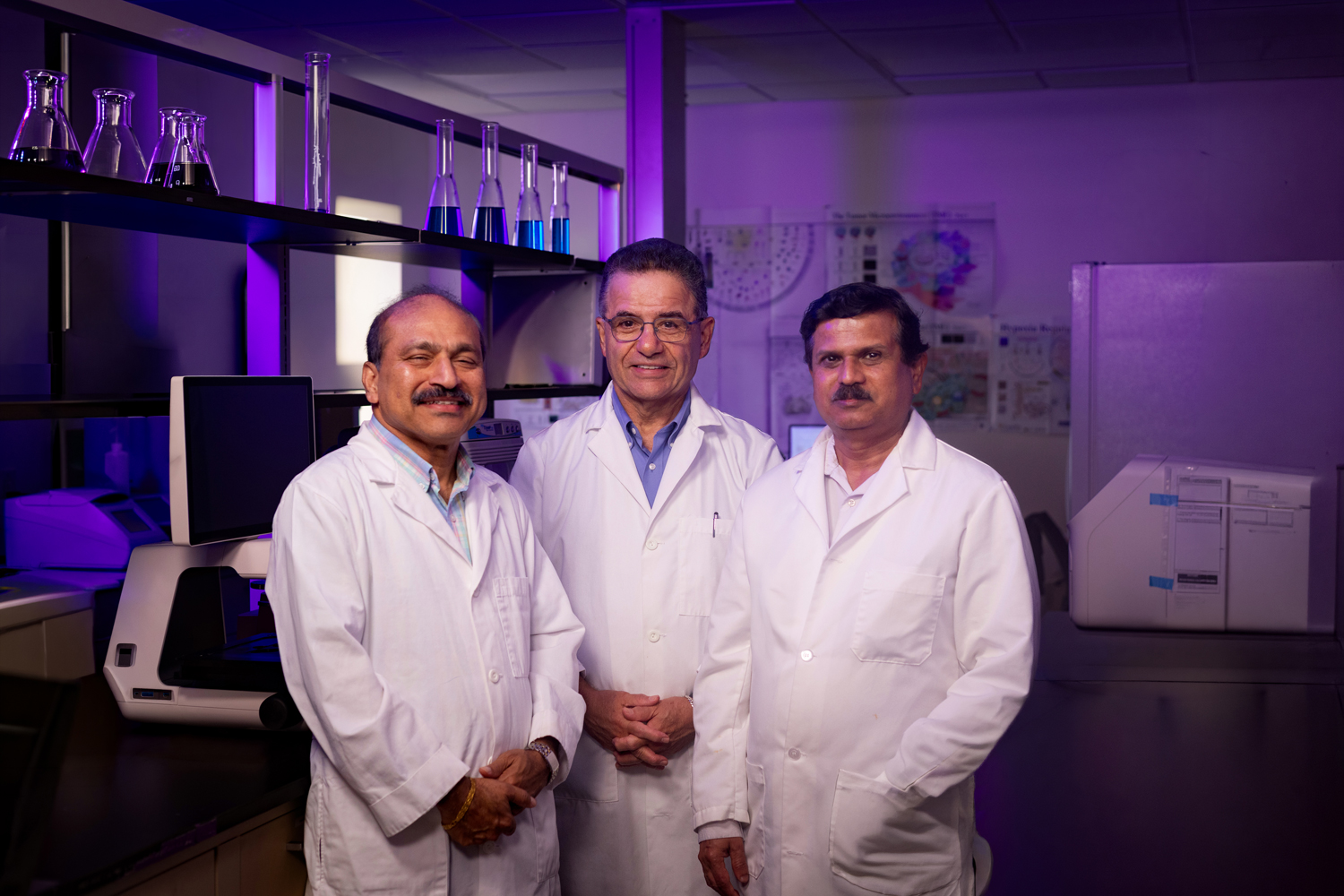
May is National Cancer Research Month. Pictured are three leading cancer researchers at LSU Vet Med: Drs. Joseph Francis, Konstantin "Gus" Kousoulas, and Seetharama Jois.
Cancer remains one of the leading causes of death worldwide, and yet fewer than 5% of anti-cancer drugs successfully move from pre-clinical research to become effective human therapies. Louisiana faces an especially severe cancer burden, with more than 25,000 new cases diagnosed each year and persistent health disparities affecting many communities. In the face of these urgent challenges, LSU School of Veterinary Medicine is accelerating its efforts to discover effective cancer therapies in a remarkable convergence of scientific disciplines that could reshape how cancer is treated in both animals and people.
These multi-faceted efforts by world-class researchers at LSU Vet Med are expanding and building a powerful collaborative network taking aim at cancer. Backed by an $11 million federal grant awarded in 2021 and poised for Phase II, LSU Vet Med's Pre-Clinical Cancer Center of Biomedical Research Excellence (COBRE) is investigating the molecular roots of how tumors form, using cutting-edge platforms like miniature lab-grown tumors built from patients' own tissue. Researchers are engineering viruses that selectively hunt and destroy cancer cells. A structural biologist is using nature-inspired peptides derived from sunflower seeds to design drugs that could outsmart lung cancer resistance. And a newly approved Center for Comparative Oncology is forming a hub connecting scientists, veterinarians, physicians, and translational researchers across LSU and partner institutions. A current clinical trial treating dogs with squamous cell carcinoma using targeted intra-tumor injections, rather than systemic chemotherapy, is already generating data that could inform future human treatments.
Work is underway to achieve the goal of National Cancer Institute designation for Louisiana that would support research that better captures the biological complexity of cancer in patients, unlock clinical trials, provide major research funding, and offer broader access to advanced cancer care.
Building the foundation: the pre-clinical cancer COBRE
A major driver of LSU’s expanding cancer research enterprise is the Pre-Clinical Cancer Center of Biomedical Research Excellence (COBRE), established at the LSU Vet Med to strengthen research infrastructure focused on understanding how cancer begins and grows. A proposal to extend the program for an additional five-year Phase II period will be submitted this year.
The COBRE program investigates the molecular mechanisms of tumorigenesis—the cellular changes that cause cancer to develop—and advances translational therapeutics, which move discoveries from the laboratory toward targeted treatments for patients.
To achieve this goal, the Center integrates innovative experimental systems designed to better predict how tumors respond to therapies. By combining both in vitro and in vivo models, researchers can examine fundamental aspects of cancer biology while developing new therapeutic strategies.
COBRE investigators are currently studying several major cancers—including osteosarcoma, breast cancer, liver cancer, and prostate cancer—to identify clinically relevant disease mechanisms and improve early-stage therapeutic testing. A cornerstone of the initiative involves advanced experimental platforms that more closely replicate real disease, including three-dimensional tumor spheroids (spherical clusters of cancer cells that recreate the complex environment of tumors), patient-derived organoids (miniature lab-grown models created from a patient’s own tumor tissue), and complementary animal models that help researchers study disease progression and treatment response.
Together, these systems allow investigators to study tumor growth, drug resistance, and therapeutic responses in environments that more closely resemble cancer in the body. By improving the accuracy and reproducibility of pre-clinical research, these tools help bridge the gap between laboratory discovery and clinical application.
The COBRE program also established a specialized Pre-Clinical Evaluation Core (PCEC) that provides scientific expertise and technical support to cancer researchers across LSU. Using advanced 3D cell-culture models, scientists can generate translational insights that help predict how tumors behave in the body, test how cancer cells respond to new drugs, and identify treatments that may be effective in animals or humans. PCEC is directed by Dr. Joseph Francis who has strong experience in both cell culture and animal models for cancer investigations. PCEC works closely with the Molecular and Immunopathology Core (MCBC) of the COBRE directed by Dr. Konstantin G. Kousoulas. MCBC employs sophisticated Next Gen sequencing technologies and advanced immunopathological analyses to assist cancer researchers.
The COBRE initiative strengthens research collaborations across Louisiana, including partnerships with Southern University and LSU Health New Orleans, while supporting long-term efforts to establish a National Cancer Institute (NCI)–designated cancer center in the state.
In addition to advancing research, the Cancer COBRE plays an important role in developing the next generation of cancer scientists. Junior investigators receive mentorship, access to shared research facilities, and collaborative opportunities with senior faculty while building independent research programs capable of securing national funding and advancing cancer solutions.
Designing targeted therapies for lung and colorectal cancer
Within LSU Vet Med’s Department of Pathobiological Sciences, Dr. Seetharama D. Jois, professor of cancer immunology and computational and structural biology, focuses on designing new molecules to treat cancer and inflammatory diseases.
One major focus of his work is non-small-cell lung cancer (NSCLC), which accounts for nearly 85% of lung cancer cases. Despite the development of targeted therapies known as tyrosine kinase inhibitors, survival rates for NSCLC patients have not improved significantly in more than a decade.
Dr. Jois’ research seeks to design molecules that block epidermal growth factor receptor (EGFR) dimerization, a critical step in tumor development. His laboratory uses nature-inspired peptides derived from sunflower seeds to build drug-like molecules capable of interfering with cancer-causing protein interactions.
These small peptide structures are unusually stable—resistant to heat, chemical degradation, and enzymatic breakdown—making them promising candidates for therapeutic development. By modifying the peptides with functional chemical groups, researchers are creating molecules that may one day serve as orally available drugs, particularly valuable when tumors develop resistance to existing treatments.
Dr. Jois also collaborates with Dr. Graça Vicente, LSU Boyd Professor and Charles H. Barré Distinguished Professor of Chemistry, to develop near-infrared (NIR) fluorescent molecules for cancer imaging.
Because most body tissues naturally emit green fluorescence, traditional imaging approaches can make it difficult to distinguish tumors from surrounding tissue. Near-infrared light, however, produces much lower background signals and penetrates tissue more effectively.
By combining NIR fluorescent molecules with targeted peptides, the researchers have created compounds capable of identifying small colorectal tumors that may otherwise go undetected in early stages. These molecules can also be used in photodynamic therapy, in which light-activated compounds destroy cancer cells.
When a compound can both detect and treat tumors, it is known as a theranostic approach—combining therapy and diagnostics within a single platform.
Supported by funding from the National Cancer Institute, Dr. Jois has published more than 120 peer-reviewed papers and contributes to teaching and mentoring students in structural biology and drug design.
Harnessing viruses to fight cancer
Another promising strategy under development at LSU Vet Med involves oncolytic virotherapy, an emerging cancer treatment that uses genetically engineered viruses to selectively infect and destroy cancer cells while stimulating the body’s immune response. This work is led by Dr. Kousoulas, professor and head of the Department of Pathobiological Sciences, and director of the Division of Biotechnology & Molecular Medicine.
Building on more than two decades of research in herpes simplex virus type-1 (HSV-1) molecular biology, Dr. Kousoulas and his team engineered an attenuated viral platform known as VC2. These modified viruses can replicate in tumor cells while remaining highly restricted in normal tissues. The viruses attack cancer in two ways. First, they directly destroy tumor cells as infected cells rupture and die. At the same time, the process releases tumor antigens that stimulate immune cells to recognize and attack remaining cancer cells.
Current researchers are taking the herpes virus (the kind that causes cold sores) and modifying it in a lab so that when it infects a tumor, it also releases a chemical signal that wakes up the immune system and tells it to attack the cancer more aggressively.
In pre-clinical studies, these virus-based therapies have demonstrated highly promising results against aggressive cancers including melanoma, breast cancer, and pancreatic ductal adenocarcinoma. By infecting tumor cells, the viruses trigger tumor cell lysis and release tumor antigens while simultaneously recruiting and activating immune cells within the tumor microenvironment. This dual mechanism, direct tumor destruction combined with immune activation, offers a promising strategy to overcome resistance to conventional therapies and improve patient outcomes.
Through collaborations with investigators across LSU campuses, the LSU Health Sciences Center in New Orleans, and regional biomedical partners, Dr. Kousoulas’ work integrates virology, immunology, and translational cancer biology—helping position LSU as a leader in virus-based immunotherapies.
CAR-T therapy has revolutionized treatment of certain blood cancers, however, many patients relapse after initial remission because CAR-T cells lose function (“exhaustion”) and lose their ability to fight cancer or chronic infections due to persistent stimulation. Drs. Weishan Huang and Gianluca Veggiani, faculty members in the Department of Pathobiological Sciences and members of the Cancer COBRE, focus on reprogramming the internal signaling of CAR-T cells, particularly through targeting IL-2–inducible T cell kinase (ITK). Their studies show that modifying or removing ITK can reduce T-cell exhaustion, improve persistence of CAR-T cells in vivo and lead to better control of tumor relapse. Their work involves engineering immune cells for therapeutic purposes that can work more efficiently alone or in combination therapies with other cancer drugs.
Comparative oncology: bridging animal and human cancer
In January 2025, the Louisiana Board of Regents approved the creation of the Center for Comparative Oncology (CCO) at LSU, led by the School of Veterinary Medicine under the direction Dr. Joseph Francis, professor in the Department of Comparative Biomedical Sciences.
Comparative oncology offers a promising approach to improving outcomes. The field studies naturally occurring cancers in companion animals, particularly dogs and cats, whose tumors often closely resemble human cancers in genetics, tumor biology, disease progression, and treatment response.
Because pets share the same environments as their owners, they are exposed to many of the same environmental risk factors. As a result, naturally occurring cancers in animals provide highly relevant models for studying disease biology and evaluating new therapies.
The new Center integrates these naturally occurring cancers with advanced experimental platforms such as patient-derived tumor organoids, three-dimensional tumor spheroids, and advanced preclinical models.
The Center serves as a collaborative hub connecting scientists, veterinarians, physicians, and translational researchers across LSU and partner institutions, including the LSU Health Sciences Centers, LSU Agricultural Center, and Pennington Biomedical Research Center.
Together, these approaches allow researchers to study cancer in ways that more accurately reflect the complexity of disease in patients.
Operating within a One Health framework, the Center strengthens Louisiana’s cancer research infrastructure while training the next generation of cancer scientists.
The Center serves as an important link in the long-term goal of achieving National Cancer Institute designation for a Louisiana cancer center—an achievement that would expand clinical trials, research funding, and access to advanced cancer care across the state.
From laboratory discovery to clinical trials
The translational nature of LSU’s cancer research extends to clinical trials involving veterinary patients. LSU’s Center for Clinical Innovation is conducting an ongoing clinical trial for dogs with non-metastatic squamous cell carcinoma.
Traditional chemotherapy is typically administered intravenously, allowing the drug to circulate throughout the entire body. In this study, researchers are testing direct intra-tumor injections of chemotherapy, delivering the drug precisely to the tumor site.
The study follows participating dogs over 11 visits over four months, including physical examinations, laboratory testing, imaging, and tumor measurements to evaluate treatment response.
The goal is to determine whether localized drug delivery can improve treatment effectiveness while reducing systemic side effects.
Such clinical trials not only provide new treatment options for veterinary patients but also generate valuable insights that may inform future cancer therapies for people. More information is available at Center for Clinical Innovation: CCITrials@lsu.edu.
At LSU Vet Med, cancer research across laboratories, clinics, and collaborative research centers is making significant inroads with a shared goal: discovering and transforming cancer treatments to save and better the lives of humans and animals.