
Expanding professional skills to prepare students for veterinary practice
February 10, 2026
Veterinary skills instruction traditionally involves teaching hands-on, medical aspects of veterinary practice such as diagnosing illnesses, performing surgery, administering treatments, interpreting lab results and more. LSU School of Veterinary Medicine is expanding skills offered to better prepare students for veterinary practice. In 2024, Rob Simpson, DVM, JD, assistant professor and director of professional development education, began teaching veterinary students professional skills, such as practice management, financial literacy, professional development, and regulatory and legal compliance.
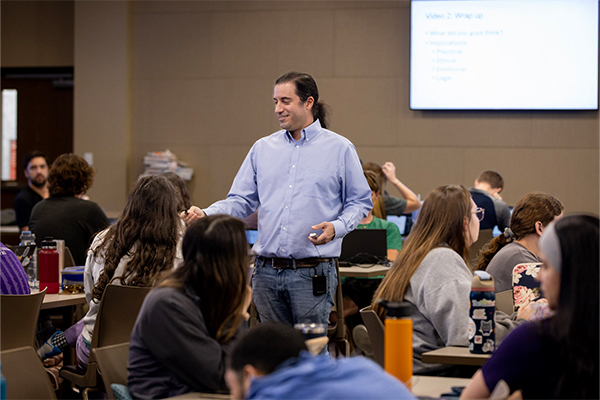
Dr. Rob Simpson teaching professional development skills to veterinary students at LSU Vet Med.
“We are developing leaders. When I was in veterinary school, we didn’t have a professional skills program. It took years to develop the skills necessary to manage a team and deal with clients,” Dr. Simpson said.
At LSU Vet Med, the focus is to create Day 1-ready veterinarians. Year 1 students begin to learn communication skills and resume writing. Year 2 students learn spectrum-of-care (offering clients a range of options), medical records, ethical decision making, and advanced communications, including how to share difficult news. Year 3 students learn about controlled substances policies, jurisprudence matters—such as legal standards for issues like licensing, malpractice, veterinarian-client-patient relationship, and animal cruelty—contract law, Board complaints, negotiating and interviewing skills.
“Seeing our students grow is the most enjoyable part of my job. It’s pretty magical. I’m proud that what we’re doing with veterinary student preparation is working. Our students come from such different backgrounds. Some arrive directly from undergraduate programs and others have had two or three careers before entering vet school,” he said.
The Communications Lab curriculum is expanded to over 30 hours of instruction. Labs are team taught. An exciting cross-disciplinary collaboration with the LSU School of Theater, launched in September 2025, trains theater students to play the role of veterinary clinic clients in simulated client workshops where veterinary students learn to communicate with clients. Theater students receive course credit by enrolling in a fourth-year undergraduate elective course.
“Not many other veterinary schools offer our level of professional skills program. Much of what we do is derived from human medicine with techniques that began decades ago,” he said.
Specializing in both veterinary medicine and law, Dr. Simpson’s influence on professional development education extends to a national level. For the second time, he is serving as the president of the American Veterinary Medical Law Association (AVMLA) board. The AVMLA is an educational non-profit organization dedicated to providing resources on the legal and business aspects of veterinary medicine for professionals in both the veterinary and legal fields with a mission to enhance the understanding and application of veterinary law through education and collaboration.
"During my first term, I ensured that students receive free membership, and I plan to continue this initiative through outreach efforts. Veterinary students need to become proficient in all aspects of veterinary medicine, and that includes the ability to do business with and explain things to the general public," he said.