

LSU Research Insights: The Future of Coastal Monitoring and Resilience with George Xue
December 08, 2025
Zuo “George” Xue, a professor in the LSU College of the Coast & Environment with a joint appointment at the Center for Computation and Technology, reflects on the future of flood forecasting and how we protect our coastal communities in the face of intensifying storms.
2026 & Beyond
As we enter a new year of research and discoveries, our LSU experts are looking forward to the biggest challenges we will face and advances we can anticipate. What might our future look like, “soonish”? How can we help to shape the future we want to see?

Digital twin of Bourbon Street during Hurricane Ida (August 29, 2021, 8:30 PM), visualizing street-level flooding driven by LSU’s AI-Enhanced compound flooding model.
“ I believe 2026 will be a turning point, when more people begin to fully recognize the transformative power of combining AI with digital-twin technologies. This integration can usher in a new era of hazard mitigation—one in which forecasts are faster, more accurate, and tailored to community needs—ultimately helping us build more resilient coastal environments. ”
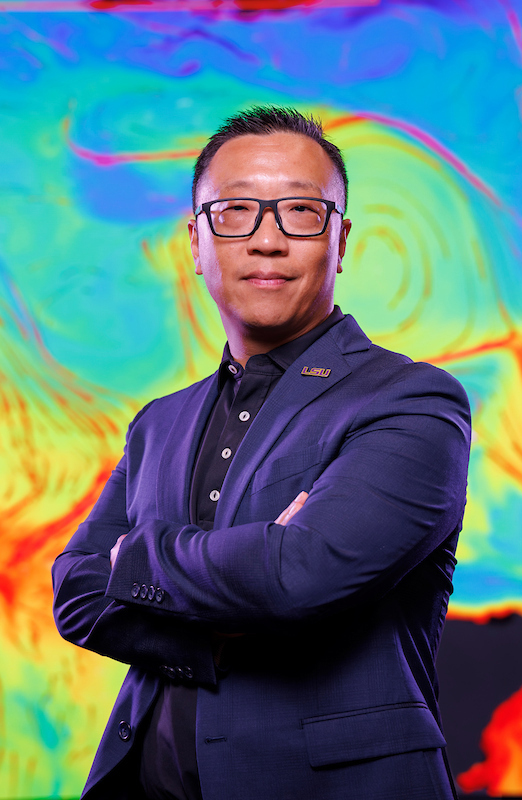
Zuo “George” Xue,
LSU professor
Where do you see your field going in the next 1–5 years?
I expect rapid expansion of AI and machine learning in flood forecasting and coastal hazard modeling. We are moving from proof-of-concept studies to large-scale, operational systems that can run thousands of simulations in seconds—something impossible with traditional numerical models alone.
By 2026, we will likely see a significant increase in published case studies demonstrating how hybrid numerical–AI approaches can improve forecast accuracy, speed, and ensemble capability across diverse flood scenarios.
At the same time, new advances in AI architectures and training strategies will begin to transform how we build, calibrate, and validate coastal models, opening the door to next-generation early-warning systems and adaptive digital twins for coastal communities.
Editor’s note: Numerical models solve problems and predict scenarios with physics equations and step-by-step math. AI models analyze vast amounts of data and look for patterns that enable them to solve problems without necessarily knowing the math upfront. This can be extremely valuable for finding new and practical patterns, but it can also limit our ability to understand how AI models make their decisions. This is why combining AI approaches with numerical modeling and real-time sensing of environmental conditions is important.
Simulation of Hurricane Gustav from Xue’s lab group at LSU.
What challenges do you foresee in your field within the next year that will need addressing?
Xue: One major challenge is the accuracy and reliability of the weather forecasts that drive both numerical and AI-based flood models. Even the best hydrodynamic or machine-learning system can only perform as well as the atmospheric inputs it receives. Another persistent challenge is the uneven availability of in-situ data—particularly local water-level sensors, rainfall gauges, and high-quality ground observations critical for training and validating AI models.
Data density is often highest in urban or well-funded regions, while rural and vulnerable coastal areas remain under-instrumented. This imbalance limits model performance and creates disparities in forecasting capability. Addressing these data gaps will require sustained investments in sensor networks and more accessible data-sharing frameworks.
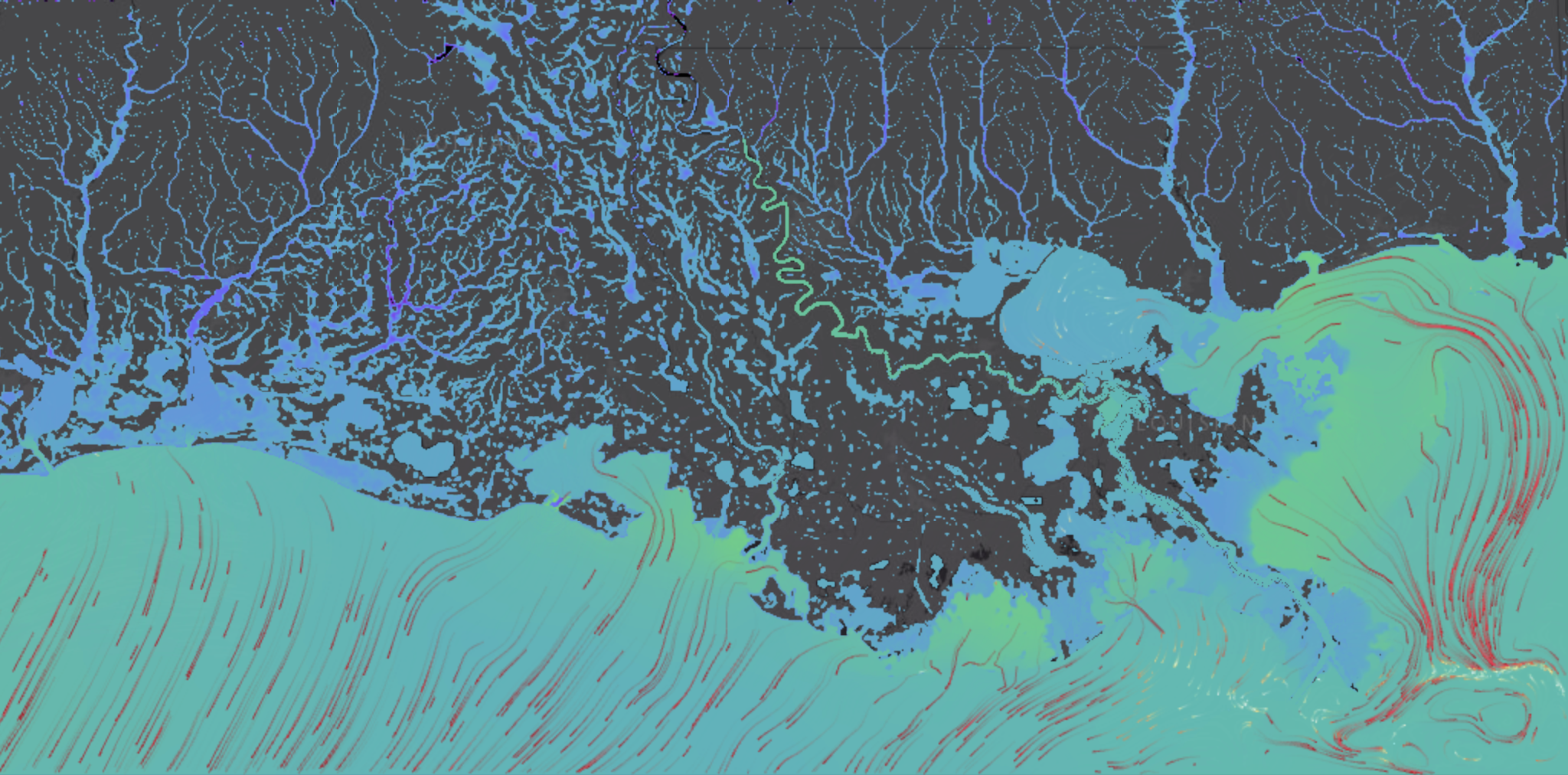
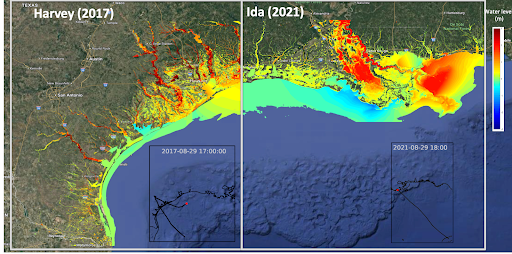
A screenshot from the Coupled Ocean Modeling group’s operational forecast model, which uses data from the Gulf of Mexico Coastal Hazards Forecast System.
Where would you like to see your field go in the next 1–5 years?
Xue: In the next five years, I would like to see the field move decisively toward the development of true, community-centered digital twins—platforms that integrate data from every relevant source, including sensors like water-level sensors, remote sensing, social media, and both numerical and AI-based models. A digital twin should function as a central hub that synthesizes real-time information and provides meaningful, high-resolution insights for planners and emergency managers.
Editor’s note: A digital twin is a virtual copy or simulation of a physical object, process, or system, used to monitor events, simulate outcomes, and inform decision-making
What are you most excited about in terms of future research and discoveries?
Xue: I am most excited about seeing the first real-world pilots that move us closer to operational digital twins. We are beginning to build prototype systems and foundational model infrastructures that integrate AI, numerical models, and real-time data streams in a more unified way. While full decision-support platforms are still a few years away, these early pilots represent important steps in that direction. They will allow us to test workflows, evaluate data integration methods, and better understand what it takes to scale digital-twin technologies for community use. This transition—from conceptual development to practical, field-tested prototypes—is one of the most promising developments I anticipate in the coming year.
What do you wish more people knew about your area of research and its implications?
Xue: I wish more people understood how essential accurate flood forecasting is—not just as a scientific endeavor, but as something that directly saves lives and reduces economic losses. Every improvement in prediction skill helps communities make better decisions, avoid damages, and recover more quickly.
While AI is opening exciting new possibilities, it does not replace the need for long-term investments in fundamental data collection and physics-based modeling. High-quality observations, sustained sensor networks, and continued study of the underlying mechanisms that drive floods are all critical pieces of the puzzle. AI can greatly amplify our capabilities, but only when supported by a strong foundational science base.
Next Step
Discover stories showcasing LSU’s academic excellence, innovation, culture, and impact across Louisiana.