



LSU Research Bites: New Genome Study Explains How Hero Shrew Got Its Superhero-Worthy Backbone
March 25, 2026
The hero shrew—scientific name Scutisorex somereni—is a rather unassuming, small grayish-brown mammal living in the forests of the Congo in Sub-Saharan Africa. But don’t be fooled. It has a unique, superhero-worthy evolutionary anomaly: a spine composed of interlocking vertebrae, like a multi-layered zipper.
This unique axial skeleton gives the hero shrew a superpower. Its backbone can withstand incredible compressive forces; some say it can support the weight of a full-grown man standing on it.
“On a collecting expedition to the Congo, naturalist Herbert Lang witnessed a 160-pound man stand on top of a hero shrew on one foot for several minutes. When he stepped off, the hero shrew recovered and ran away unharmed,” said Austin Chipps, a former graduate student in Jacob Esselstyn’s Lab at the LSU Museum of Natural Sciences.


Chipps is now a predoctoral research fellow at the Smithsonian National Museum of Natural History. “Resistance to such dorsoventral compression, while impressive, remains a mysterious feature of the hero shrew axial skeleton, and we still lack an understanding of how this trait is adaptive.”
While scientists are still unraveling the mysteries of this shrew, locals in the Congo have known about it for centuries and seen it as a symbol of strength. Some have carried the shrews’ bones with them on hunts or into battle.
Chipps reasoned that the answer to how the hero shrew got its odd skeleton must be in its DNA.
Almost all other mammals share a fairly similar “beads on a string” backbone (where each bead is a vertebra), inherited from a common ancestor. Some other animals, including armadillos, have extra spiny projections on their vertebrae that interlock, increasing spinal rigidity. But no other animal has nearly as complicated an interlocking system as the hero shrew. What genetic variation gave rise to this anomaly?
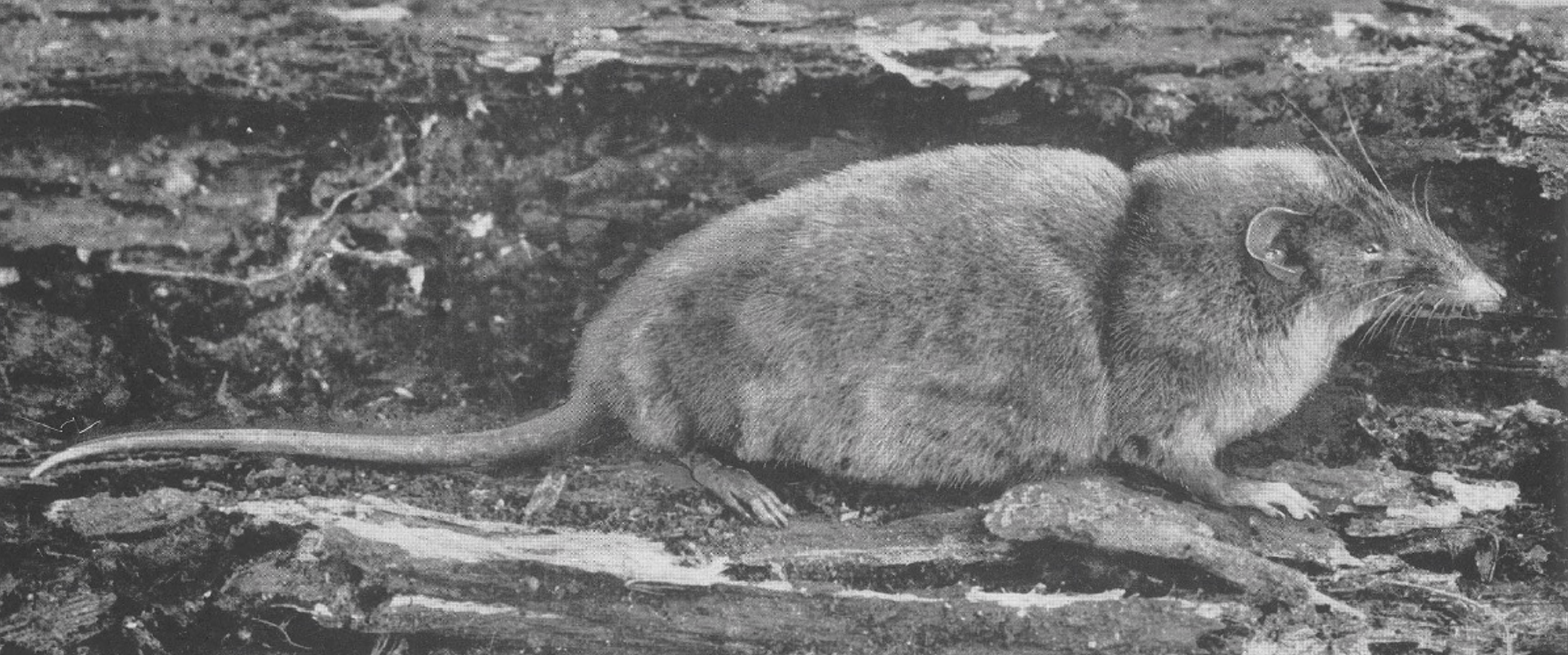
Hero shrew
A Genetic Mystery

Austin Chipps
“Biologists are obsessed with trying to find the link between genetic variation and traits of an organism,” said Chipps. He and his colleagues are the first to undertake a study to find the link between this shrew’s genetics and the evolution of its unique backbone.
Genetic sequencing technologies are increasingly ubiquitous, allowing researchers to sequence large genetic datasets quickly and cheaply. Researchers can use DNA and RNA sequencing to get the exact DNA “letter” sequence of an organism’s genome, identify genes, find those genes’ on and off switches, and observe how genes get expressed into proteins and other elements that do the work in every organism’s cells.
Using genetic sequencing technologies, researchers have made great progress toward understanding the link between genes and observable traits in animals such as fruit flies, lab rats, and other commonly studied organisms. However, the relationship between genes and physical traits remains poorly understood for most wild animals.
To determine the link between the hero shrew’s genome and its crazy, massively interlocking skeleton, Chipps and colleagues at LSU first had to sequence this animal’s genome.
“We had to sequence, assemble, and annotate the hero shrew genome and find ways to compare this genetic sequence to those from a diverse sample of mammals,” Chipps said.
The researchers then combined this information, the full sequence of the shrew’s genetic material, with publicly available genomes from 30 other mammal species spanning millions of years of evolutionary history. This way, they could search for genes that differed between hero shrews and these other mammals.
Genetic Answers
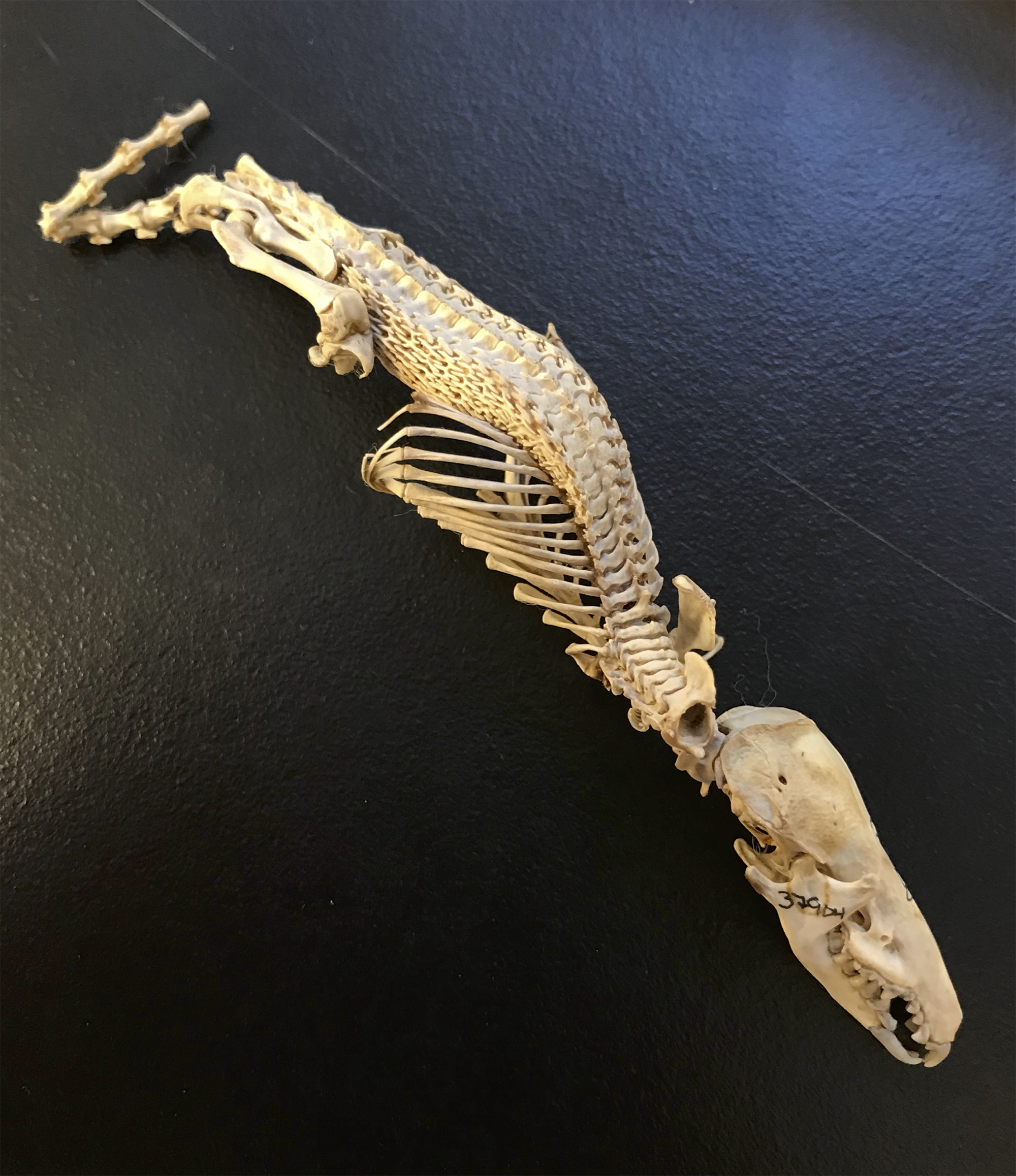
Hero shrew skeleton
Genomes are complex, and comparing the genomes of different animals to identify which genes are responsible for a given trait is not as straightforward as it sounds. But Chipps and colleagues were excited to narrow in on some of the genes that may be responsible for the hero shrew’s odd backbone.
These genes include HOXA10, HOXA11, ALX4, and CRKL, which collectively play roles in skeletal, musculoskeletal, and limb development, as well as in the growth, specialization, and movement of different cells during development.
“We originally hypothesized that these and similar genes might play some role in the evolution of this trait, but remained cautiously optimistic throughout the study,” Chipps said.
HOXA10, HOXA11, ALX4, and CRKL are critical genes for development in all animals with backbones, meaning they should be highly conserved.
“In other laboratory studies, changes to these genes lead to severe developmental defects in organisms,” Chipps said. In organisms other than the hero shrew, that is.
Changes to these genes appear to have conferred a unique advantage for the hero shrew, although it is still not clear exactly what the advantage is! Some researchers have guessed that an interlocking backbone could help the hero shrew squeeze into tight spaces without harm, but more research is needed.
For now, Chipps is betting on DNA to provide more answers and directions for research. He hopes the approach he and colleagues used to study the hero shew’s backbone will serve as an example for others seeking to understand the relationship between genetic variation and physical traits in species whose genomes aren’t fully sequenced yet.
This study also highlights the importance of natural history museum work to biodiversity research.
“Without specimens of the hero shrew, we would never know of this enigmatic axial skeleton. Without modern specimen collection, we would lack the tissue samples that were critical for our genetic work,” Chipps said.
Read the study: Genome Evolution and the Enigmatic Axial Skeleton of the Hero Shew (Soricidae: Scutisorex Somereni)