


LSU Graduate Student Supports NASA’s Artemis II Mission Through Film and Archival Work
April 14, 2026
By day, John Hughes is a full-time employee at NASA. By mission, he’s helping document history, while also pursuing his graduate degree at LSU. Hughes is pursuing a dual degree in Library & Information Science and Archival Studies, blending academic study with hands-on field experience.
Thanks to support from LSU’s Pinkie Gordon Lane Graduate School, he’s able to continue his education while working in the field he’s passionate about. At NASA’s Johnson Space Center (JSC), he plays a key role in the Artemis II mission, organizing and archiving the visuals that capture history in the making. With a background in cinematography and an expected graduation in 2028, Hughes has been spending the spring semester working as a Film & Video Librarian, helping catalog the mission’s visual history.
While Artemis II was on its journey back home, Hughes shared insights into his experience working on the record-breaking mission.
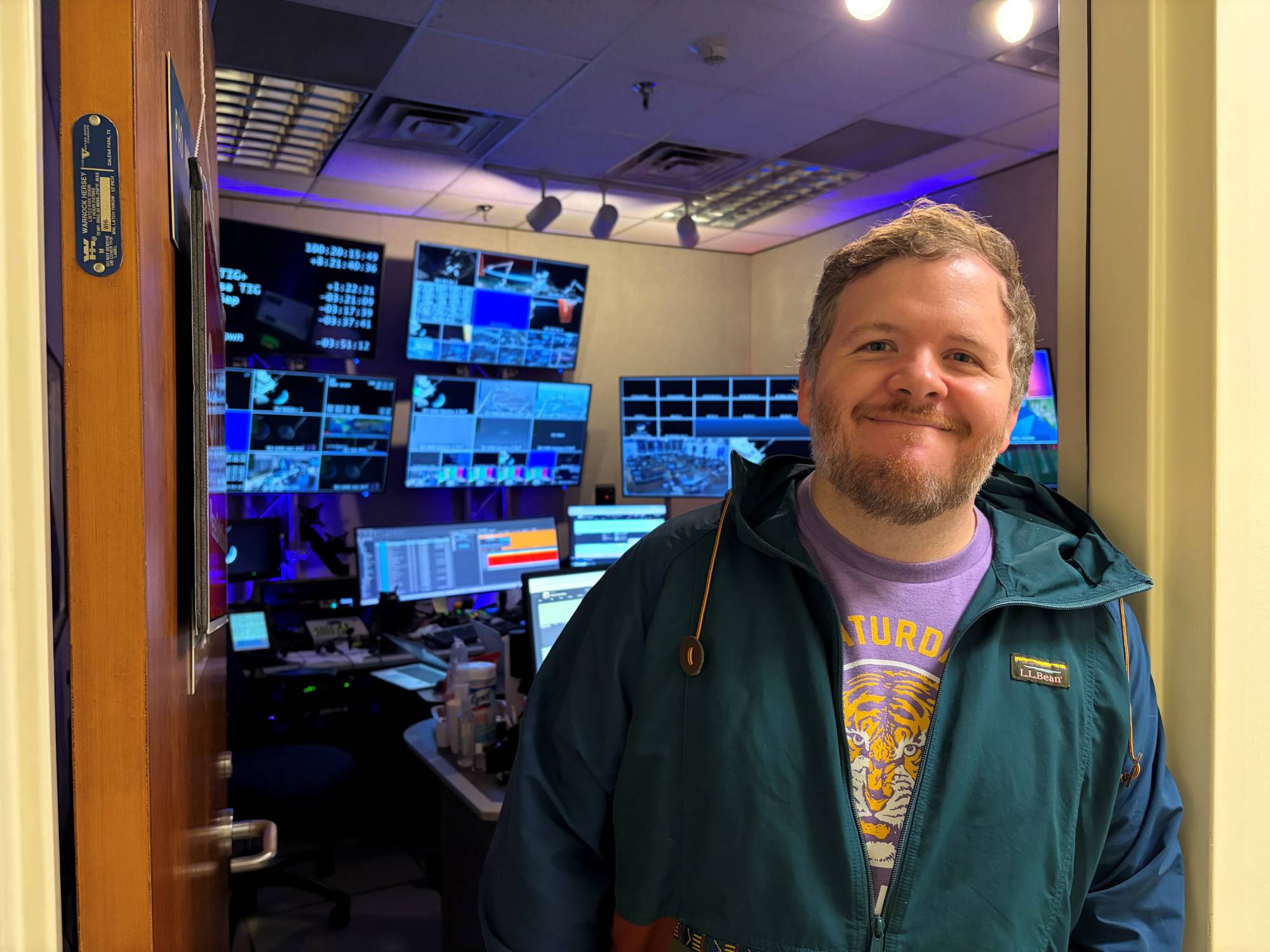
LSU graduate student John Hughes played a key role in the Artemis II mission.
Can you explain what you are doing in relation to Artemis?
My official title here at NASA is Film & Video Librarian. While Artemis is on its 10-day mission, we receive thousands of photos and videos every day. Whether those be from the external cameras mounted on Integrity (the Orion spacecraft that the Artemis II crew is aboard), the internal cameras that we use to keep in communication with the crew while they work with the grounds teams on all of their incredible mission responsibilities, or photos and videos that the crew themselves have been taking like all of the truly unbelievable photos of the lunar surface and Earth that you’ve likely seen all over your various social media feeds. All of that imagery eventually makes its way to the Moving and Still Imagery Repositories where myself and others go through all of it, making sure that each clip and photo is accurately cataloged with descriptions of what all crew, ship components, science activities, equipment, etc. are involved in the footage so that it can be cataloged and archived for educational use, public access, research studies, documentaries, and any number of other things that current and future generations might need it for.
How are you balancing this work and your dual degree?
The flexibility that LSU provides its students is really the only reason I’ve been able to pursue my degree at all while being a part of the team here at NASA. With Artemis II on the schedule, I was able to take off the second spring term from LSU and focus solely on my duties here without worrying about any additional grad school responsibilities, knowing I could pick back up in the summer without missing a beat. That level of flexibility was a big factor in my choosing to attend LSU in the first place, and I couldn’t be happier that I did.


How will this experience help the education you’re pursuing at LSU and your desired career path?
Artemis has only reassured me of my decision to pursue a master's at LSU. Rounding out my film-focused education and background with the Information Science and Archival Studies
aspects of the dual degree plan that LSU offers is only going to allow me to be better at the work I’m
already lucky enough to be doing.
Describe the emotions leading up to the launch and while on its mission?
The launch was equal parts exciting and a relief. So many people have been working on this mission for years, my wonderful wife Sarah among them, and to see it get off the ground was awesome. Not just because it was the start of this history- making mission that’s captivated so much of the world’s attention and inspired so many people, but because I knew a lot of folks who were finally going to be able to take a half step back and realize just how worth it their years of work had been.
Since we’ve been on mission, I think the prevailing feeling around JSC is just awe.
Every flight day has come with something that has completely blown everyone away.
It’s a good time to be at NASA, that’s for sure.
Where are you doing this work? What does a day in your life look like?
I work at the Johnson Space Center here in Houston, Texas. I don’t imagine my days look that exciting from the outside, as it’s mostly just me sitting at a computer surrounded by thousands of old film reels and photo negatives from past missions, but I do get to come in everyday and see what the Artemis II and International Space Station (ISS) crews have been up to since I left and know that I’m a very small part of making this whole thing work.
Anything else you’d like people to know?
That we’ll still be here even after Artemis II. There’s always something happening at NASA, whether it be launches, spacewalks, education events, etc. So, if you find yourself with a new interest in science and space, we would love for you to stick around and keep watching and supporting. It genuinely means the world to everyone here.