


LSU Researchers Generate Electricity without Fuel
May 25, 2026
More than 60% of the energy generated by wind, solar, natural gas or coal power never makes it to the customer. Most of it is lost during the conversion to electricity. The resulting higher fuel consumption and electricity costs hurt consumers and businesses.
LSU researchers have invented a way to generate green electricity that under lab conditions is as efficient as natural gas-fired power plants and more efficient than those fueled by coal, wind or the sun. However, those numbers would be affected by scaling up.
The discovery relies on connecting two composite materials, which change from solid to liquid and liquid to solid at different temperatures and electrical conductivity. Those differences can produce electricity.
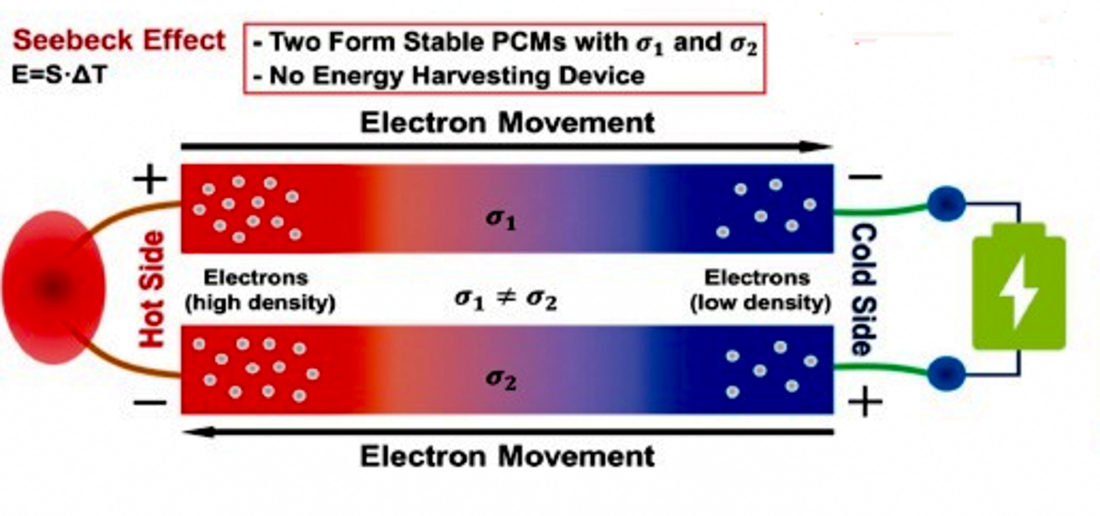
“Only a small temperature difference is needed -- 1.8 degrees Fahrenheit, or 1 degree Celsius, will trigger energy harvesting,” LSU Professor of Mechanical Engineering Guoqiang Li said. “When we connect these two phase-changing materials, electricity is produced.”
Li and Postdoctoral Researcher Chengbin Yu’s invention that lab testing shows has an energy conversion efficiency of 50% at a temperature difference of 18 degrees Fahrenheit, or 10 degrees Celsius. The greater the temperature difference, the higher the electricity output.
The researchers experimented with two methods to create conductivity differences and capture electricity. One method uses carbon nanotubes as conductors for the electrons that generate the electric current. The other uses water and carbon dioxide.
“Our process does not add carbon dioxide to the atmosphere, so it is a sustainable, environmentally friendly form of energy,” Li said.

Mechanical Engineering Professor Guoqiang Li and Postdoctoral Researcher Chengbin Yu
Some of the applications the researchers are exploring include connecting a tank of sun-warmed salt water on the roof of a building to another tank inside the building to capture the temperature difference needed to generate electricity. Another is using the waste heat vented by an industrial plant to warm a tank of salt water connected to another tank at ambient temperature.
Although other media can be used, salt water is cheap, abundant and can store larger amounts of heat than fresh water alone, Li said. This could make the technology particularly useful and accessible along coasts, but if there isn’t a ready supply of salt water, it’s also easy to make by adding salt to fresh water.
After successful lab tests of their invention, Li and Yu are eager to attempt a larger trial to improve the output voltage and current, an effort that will require partnering with the energy industry.
The inventors are optimistic their process has commercial potential. The ingredients needed to fabricate the composite materials are already on the market, and the only implementation costs would be for initial construction, maintaining the temperature and conductivity gradient, and maintenance since no fuel is required. Fuel normally accounts for 40%-60% of the operating costs for coal power plants and 60%-80% for natural gas plants.
License this Invention
LSU, through its Office of Innovation & Technology Commercialization (ITC), is seeking partners to help bring the discovery to market. For licensing inquiries, contact techlicensing@lsu.edu.
“This pioneering work by our brilliant scientists helps position LSU as a leader in sustainable energy solutions that will transform the future of power generation,” LSU Vice Chancellor of Research and Economic Development Robert Twilley said.
Li and Yu worked with LSU’s Office of Innovation & Technology Commercialization (ITC) to pursue patent protections for the nanotube and carbon dioxide methods.
“We are excited to work with Drs. Li and Yu to pursue the potential for these breakthrough technologies,” said Grace Myers, ITC senior commercialization officer.